Wednesday, May 12, 2010

Final days of Eire


As our time in Ireland is winding down, I thought I would reflect on what made our trip the amazing experience it was. I'll never forget my time here, and I know I'll be back to visit all of the wonderful people who made our ten weeks here as unforgettable as they have been.

Without our friends Tom Keith, Joe Moynihan, Joe O'Flaherty, Fearghal Reidy, and many many others, we wouldn't have gotten the opportunity to come to Dungarvan. We owe this experience to their selfless hard work and determination to bring the students of Mercyhurst to Dungarvan. On the other side of the pond, Dr. Hosey, Dr. Reed, Dr. Synder, Dr. Federici, Dr. McGurk, and Ms. Miller were all so amazing in giving up their personal time and lives in Erie to come to Ireland with us and be our teachers and friends. There are also a few locals who deserve a shout-out. Our best Irish friend-Eoin-did so much for us over our ten weeks here. From taking us to the Blarney Stone to simply being our friend when we were so far from home, his contribution to this experience was awesome. Everyone that we have met here has been so incredible to us.

When we arrived, I was apprehensive about spending so much time away from everything I knew- friends, family, school and work. Now I know that I am more than capable of doing things for myself. Studying abroad has given me the confidence to know that I can be a more independent person. Being in Ireland has also helped me learn to enjoy life, and take things as they come. Before Ireland, I fear that I took everything far too seriously- certainly not a problem in Ireland. In such an easygoing place, it was wonderful to just be able to sit back and be on "Irish Time" for a while.

The friends I have made here will be lifelong. They have really made the experience what it was for me. Without these people- people who I have probably seen around campus hundreds of times without knowing who they were- my personal Ireland experience would not have been as wonderful. Talking to friends who have done their study abroad experience alone, I am so thankful that I could share mine with 25 other Mercyhurst students who have become some of my closest friends.

Bright Star

Bright star, would I were steadfast as thou art-
Not in lone splendor hung aloft the night
And watching, with eternal lids apart,

Like nature's patient, sleepless Eremite,
The moving waters at their priestlike task
Of pure ablution round the earth's human shores,
Or gazing on the new soft-fallen mask

Of snow upon the mountains and the moors-
No--yet still steadfast, still unchangeable,
Pillow'd upon my fair love's ripening breast,
To feel for ever its soft fall and swell,
Awake for ever in a sweet unrest,
Still, still to hear her tender-taken breath,
And so live ever--or else swoon to death.

In class, we read John Keats' poem "Bright Star" during our study of the romantics. Keats was one of my favorite poets that we read, and "Bright Star" is one of his most well known works. Recently, a book of love letters written by Keats to his lover Fanny Brawne has been published under the title "Bright Star," and a movie has been made based upon the book. Throughout my blog, I'm sure you'll notice the references to and reviews of movies- I am a huge fan of movies and I enjoy connecting them to what we've been studying in class.

I decided to watch the film "Bright Star," directed and screenplay by Jane Campion, starring Abbie Cornish as Fanny Brawne and Ben Whishaw as John Keats, to see what all the fuss was about. Aside from it using the letters and names of Keats and Brawne, for me it didn't capture the essence of Keats' poetry. His letters to Fanny are beautiful, however. The movie was a good love story, but didn't seem to have the same meaning that his poetry, such as "Bright Star" itself has. The poem itself is a tribute to Fanny. In the poem, he references religion, as well as the north star- perhaps she is his religion and his guiding star?


Wednesday, May 5, 2010

The Playboy of the Western World


Because of my trip to London, I missed our class discussion of John Millington Synge's "The Playboy of the Western World." After reading it on the bus to Cork on the first leg of my journey to London, I began to think about Ireland and what it means to be Irish. Synge's characters are very distinctly Irish- from the way that they act to their manner of speaking.

This play was one of my favorite pieces we read throughout the class- something about it really attracted me (much like the women in the play are mysteriously attracted to Christy!). When Christy first entered the play, I wasn't exactly sure how to take his character. I didn't want to like him, obviously, because he had claimed to have killed his own father! But then all the women start going crazy over him- who gets to make his dinner, whose house he gets to stay in, etc.- and me as a reader wasn't sure what to think anymore.

In the end, I decided that I disliked Christy, not only because he lied about murdering his father, but he became very clingy towards Pegeen at the end- claiming to be in love with her when he had only known her for a few days, etc. I couldn't understand Pegeen's response to Shawn at the end of the play, when she said "Quit my sight. Oh my grief, I've lost him surely. I've lost the only Playboy of the Western World," I was surprised that she would be so sad about losing a man who was a liar, and possibly even a murderer.

London


I want to preface this blog by saying that it was wonderful to see my best friend again after 5 months apart! Don't get me wrong, London was a really cool city. But I was disappointed by it. I didn't expect to identify with what Blake writes in his poem "London":

I wander thro' each charter'd street,
Near where the charter'd Thames does flow,
And mark in every face I meet
Marks of weakness, marks of woe.

But after walking around the city and down the Thames, I can see exactly what he was talking about. I enjoyed my time in the city, but the whole time I'm sure I was talking about Ireland like an infatuated schoolgirl- Ireland this and Ireland that! I said in my first blog about leaving for London that I had hoped to agree more with Wordsworth's interpretation of the city; however, I didn't fall in love with it like I though I would.

I arrived on Thursday afternoon and made my way to Victoria Station where I would meet up with Jeffrey. It probably would've been a good idea to designate a meeting place, but I wandered around for a bit and found him reading in a secluded area of the station. Off to a good start! (At least I found him!) We then got on the Underground (mind the gap!) and went to King's Cross Station. I got signed into his residence hall, and we took off to explore the city a bit.

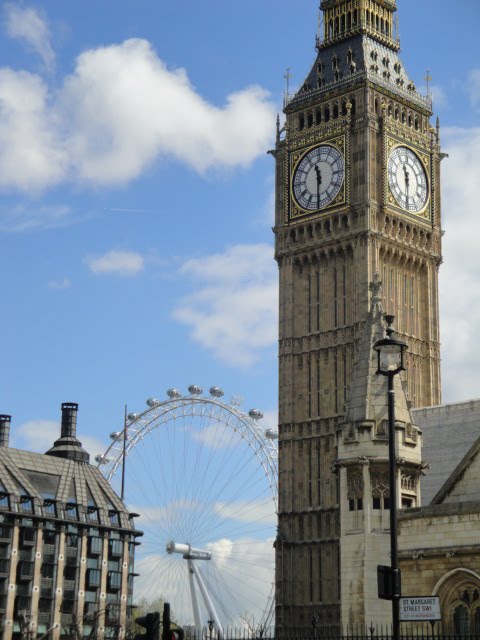
The next day, after a failed attempt at visiting Platform 9 and 3/4 to pay homage to Sir Harry Potter, we visited Piccadilly Circus (my favorite place in the city) for dinner and some souvenir shopping. We got to see many of the theaters where some of the best shows are held, which was exciting. Plus, I finally got some much-craved Mexican food- which seems almost impossible to find in Ireland! We continued exploring the city the on Saturday- Parliament, Westminster Abbey, Big Ben and the London Eye. Walking down the Thames for what seemed like hours, we came across the Tower of London- one of the only places I really wanted to see. It was awesome to see such a historical place.

Leaving London was sad in the sense that I was leaving my friend, but I was excited to get back home to Dungarvan. Sitting on the bus from Cork to Dungarvan, I looked out the window and was struck by the thought that I would soon be leaving this beautiful country. I'm not ashamed to say that it brought tears to my eyes. I can't believe how much Ireland has worked its way into my heart!

Wednesday, April 28, 2010

Departure for London

As I'm packing to leave for London tomorrow, I can't help but think about William Blake's Poem "London." Obviously, modern London is going to be quite different from Blake's London. He writes:
I wander thro' each charter'd street,
Near where the charter'd Thames does flow,
And mark in every face I meet
Marks of weakness, marks of woe.

In every cry of every Man,

In every Infant's cry of fear,
In every voice, in every ban,
The mind-forg'd manacles I hear.

How the Chimney-sweeper's cry
Every black'ning Church appalls;And the hapless Soldier's sigh

Runs in blood down Palace walls.

But most thro' midnight streets I hear
How the youthful Harlot's curse
Blasts the new born Infant's tear,
And blights with plagues the Marriage hearse.
Blake's view is not the most flattering or celebratory picture of London. He talks about the "charter'd" streets of the city, as well as the "charter'd" Thames river. For Romantic poets like Blake, nature is the most important image. To Blake, the streets and river in the city are too unnatural, too planned out. He thinks that directing and walling off the river as has been done in London makes the city an unpleasant place to be.

Hopefully, my experience with London will be at least slightly more pleasant than Blake's. I'm anticipating a bustling city full of culture and history- and my best friend of almost 15 years who happens to be studying there while I'm over here in Ireland. Should be a good reunion and wonderful weekend! Be back in good old Dungarvan on Sunday afternoon-I'll miss it!

Tuesday, April 27, 2010

Waterford and New Ross

The day after we arrived home from our visit to Co. Clare, we continued the weekend's festivities and visited St. Augustine's College, Waterford City, The Dunbrody, Good Counsel College, and the Kennedy homestead in New Ross! It was a busy end to a busy weekend!

At St. Augustine's, we were treated to a full Irish breakfast and a short tour of the school. It was nice to see where many Mercyhurst students had attended high school. Our next stop was Waterford city and the Waterford Treasures Museum, where we learned about the rich history of Waterford county and Ireland- from the Vikings to present day.

We then traveled to New Ross to visit the replica of the famine ship the Dunbrody, which carried passengers from New Ross to American during the Great Famine. Seeing the conditions in which the immigrants would have traveled really opened my eyes to how hard their journey would have been. After the Dunbrody, we went to Good Counsel College, where we were provided with a delicious dinner and the chance to meet some current students who are applying to Mercyhurst as well as a current Mercyhurst student's younger brother!

Our last stop was the Kennedy homestead located near New Ross. Visiting where President Kennedy's ancestors came from and learning about his life from a Kennedy relative was such an interesting opportunity. After a short look around, we got back on the bus and headed back to Dungarvan after a tiring weekend.

Monday, April 26, 2010

"We Are Seven"

--A simple Child,
That lightly draws its breath,
And feels its life in every limb,
What should it know of death?

I met a little cottage Girl:
She was eight years old, she said;
Her hair was thick with many a curl
That clustered round her head.

She had a rustic, woodland air,
And she was wildly clad:
Her eyes were fair, and very fair;
--Her beauty made me glad.

"Sisters and brothers, little Maid,
How many have you be?"
"How many? Seven in all," she said
And wondering looked at me.

"And where are they? I pray you tell."
She answered "Seven are we;
And two of us at Conway dwell,
And two are gone to sea.

"Two of us in the church-yard lie,
My sister and my brother;
And, in the church-yard cottage, I
Dwell near them with my mother."

"You say that two at Conway dwell,
And two are gone to sea,
Yet ye are seven! --I pray you tell,
Sweet Maid, how this may be."

Then did the little Maid reply,
"Seven boys and girls are we;
Two of us in the church-yard lie,
Beneath the church-yard tree."

"You run about, my little Maid,
Your limbs they are alive;
If two are in the church-yard laid,
Then ye are only five."

"Their graves are green, they may be seen,"
The little Maid replied,
"Twelve steps or more from my mother's door,
And they are side by side.

"My stockings there I often knit,
My kerchief there I hem;
And there upon the ground I sit,
And sing a song to them.

"And often after sunset, Sir,
When it is light and fair,
I take my porringer,
And eat my supper there.

"The first that died was sister Jane;
In bed she moaning lay,
Till God released her of her pain;
And then she went away.

"So in the church-yard she was laid;
And, when the grass was dry,
Together round her grave we played,
My brother John and I.

"And when the ground was white with snow,
And I could run and slide,
My brother John was forced to go,
And he lies by her side."

"How many are you, then," said I,
"If they two are in heaven?"
Quick was the little Maid's reply,
"O Master! we are seven."

"But they are dead; those two are dead!
Their spirits are in heaven!"
'T was throwing words away; for still
The little Maid would have her will,
And said, "Nay, we are seven!"

I know that "We Are Seven" by William Wordsworth is a pretty lengthy poem to include here, but I've declared it my favorite that we read during our study of the Romantics. In the poem, the narrator comes across a young, country girl who is one of seven children- or so she claims. While the narrator is talking to her about her brothers and sisters, he learns that two of them are dead and buried in the church-yard next to her house. In the narrator's adult, rational mind, this means that she is only one of five children, not seven. To the child, she is one of seven! This poem examines death- does the little girl understand that her brother and sister are dead (i.e, not living)? I believe that she does understand that they are dead and can't be there with her physically anymore, but to her death doesn't mean that she can't still interact with them- eat dinner with them, or go knit near them, etc. The girl isn't concerned with the restrictions of being rational, a lesson that I believe the narrator can learn from.

I recently found out that my favorite teacher from high school died- Mr. Ule taught Honors and AP Chemistry at my high school for over thirty years, and retired the year that I graduated. He taught my mother when she was a student at the same school, and used to refer to me as "Polly Jr." during class. He was a fantastic teacher and really inspired his students to enjoy learning not only Chemistry but other subjects as well. When I was taking a look through my notes and rereading "We Are Seven," I couldn't help but think about how his loss will be felt throughout my hometown.

RIP Mr. Mark Joseph Ule (December 4th 1947-April 25th 2010)